Materials#
If you’re just just interested in the conclusion and not the explanation, the short answer is: “get a steel trainer, not a synthetic/nylon trainer.”
HEMA swords come in three main flavours:
Steel vs Synthetic vs Foam#
Steel trainers are our default. You can start looking at a steel trainer once you’ve begun building up your protective kit. Once you have the main pieces, a steel trainer will actually be safer than a synthetic or foam sword. Steel trainers are based on the real thing and nothing performs quite like them: binding, beating, and parrying all feels more natural with steel trainers. These usually have larger guards than real swords to accommodate our gloves, and will taper differently in order to flex in a thrust. Some steel trainers (especially longswords) also come with feder blades, which are lighter/thinner variants designed to be less punishing to our opponents while still performing realistically.
Synthetic trainers or nylon trainers can seem like a good inexpensive alternative to steel trainers. They are similarly weighted, can hold up to a lot of abuse, and are easier to mass produce. The materials in these trainers are not as dense as steel though, meaning blades are thicker, and consequently they do not flex. It is not safe for beginners to thrust with a synthetic trainer, and even experienced fencers can be injured by leaping into a stop thrust. Synthetic trainers are fine for solo drills, but are not recommended for partner drills or sparring. Only get a synthetic trainer if you want a low-maintenance alterantive to drill at home.
Foam trainers are a good way to get started when you don’t have a lot of gear. NHF has a bunch of foam sabres and longswords so that new students can start drilling right away without having to show up to their first class in full kit. Like synthetic trainers, foam trainers do not flex and should never be used for thrusts; these are not pool noodles, but rather thick foam wrapped around a rigid centre. Foam swords don’t bind quite the same way, and sometimes bounce off each other. Don’t worry too much about: at this stage a foam sword is all you need to learn the fundamental guards, cuts, and footwork.
LARP Weapons#
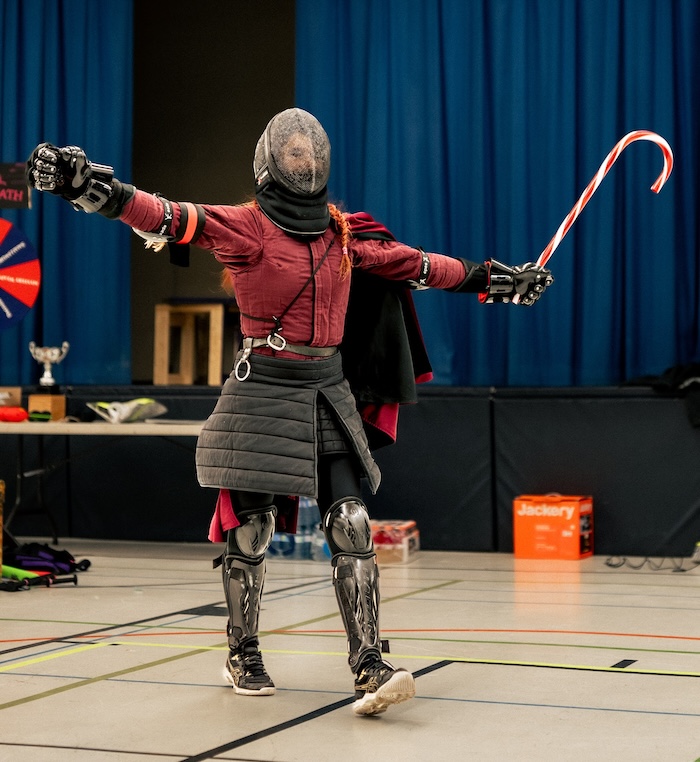
Can you use a LARP weapon in class? There’s some nuance here because the venn diagram between people who do MOF, HEMA, SCA, LARP, roleplaying, and everything in between looks suspiciously like a circle. What’s true of LARP weapons is also true of HEMA weapons: different material types don’t mix well. Steel trainers should be used with steel trainers, foams with foams, synthetics with synthetics (if at all), and LARP weapons with other LARP weapons.
Students sometimes bring LARP weapons to show off, and if you bring multiple, you might get some sparring in. LARP weapons are not suitable for partner drills though, and they are not suitable for sparring with HEMA trainers.